Memorial Bench Wording Ideas — What to Write on a Tribute Bench
Choosing the words for a memorial bench is one of those jobs that can stop you in your tracks. We see it all the time. Someone gets in touch, full of love and certainty about wanting a bench — and then comes the pause, because what goes on it suddenly feels like the most important sentence they'll ever write. It needs to be right. It needs to hold something true about a person in just a few words. And it's going to be there for a very long time.
We're a small workshop in Mid Wales, and over the years we've carved a lot of these benches — for parents, for schools, for widows and widowers, for whole communities. So this guide isn't a list of templates pulled off the internet. It's what we've learned from sitting with families and helping them find the words, illustrated with real benches we've actually made and the real inscriptions that ended up carved into the oak.
Whether you're ordering imminently or just turning it over in your mind, we hope it helps.
Why the Words Matter So Much
A memorial bench is a permanent thing, placed in a specific spot, meant to be visited and sat with. The inscription is the only voice it has. Unlike a eulogy, which is long and layered and spoken once, a bench speaks in a single brief moment — and it does so every single time someone sits down. That's a lot of weight for a few words to carry.
But here's the reassuring part: simplicity is almost never wrong. A bench that says nothing more than a name, a span of years and "Beloved Father" has done its job in churchyards for centuries. The question we always come back to with families is a simple one: what do you want someone to feel when they sit here? That's usually where the right words start to surface.
Start With the Person, Not the Quote
The mistake people most often make is searching for inscriptions in the abstract — scrolling through famous quotes hoping one fits. It rarely does. The inscriptions that land hardest are the ones built out of the actual person: what they loved, what they said, the life they led.
One of the fullest examples we've ever made is Andy's bench. Andy "Mouse" Hey was an athlete, a QPR supporter and a John Lennon believer, and his family wanted all of it. So we carved his wheelchair-sport silhouette, the badges of the teams and artists he loved, his family's names — and across the front rail, the line that was his: "Imagine all the people, living life in peace." Nothing on that bench was generic, because Andy wasn't.

Short and Simple: Name and Dates
The most traditional format is also the most enduring: full name, year of birth, year of death. That's it. No quotation, no descriptor — just the facts.
There's a quiet dignity to this. It makes no claims and it leaves room for whoever sits there to bring their own thoughts. In a beautiful setting — a view, a garden, a stretch of woodland — a name and two dates can feel completely right. A single relationship word costs nothing in complexity and adds a great deal of warmth: "Beloved Mother." "Devoted friend." "Dad."
When George Bailey's family came to us, the brief grew out of exactly this kind of restraint — a name, his dates, and one motif that mattered. We carved the England rugby rose into a single piece of oak (our carver Dan redrew it until it matched the official emblem as closely as a chisel can manage) beneath the words "In Loving Memory of George Frederick Bailey, 1961–2018." Because that's the kind of man he was.

Words That Capture a Life
Many families want something beyond name and dates — a line that speaks to how a person lived, or simply felt like them. A good quote doesn't have to be famous. It just has to be true.
Some of the most moving wording we've carved came straight from the family's own pen. Fred chose Asian elephants for his wife Sue's bench because she'd spent time in Thailand and loved them. His brief was as understated as it gets — "nothing over the top" — but he wrote both inscriptions himself. Along the seat back: "From sunrise to sunset, a blessed place from above. Each day gives a rebirth of Joy, Peace and Love." And below the seat: "Sunshine Sue, you will remain in our hearts forever, and we know your spirit dances with the stars." He sent them with the note, "Feel free to amend." We didn't change a word.

If you'd rather draw on a poet, that's a lovely route too — just look beyond the most-searched lines. For a Welsh life, R.S. Thomas or Edward Thomas might feel more particular than a famous name; Dylan Thomas carries a weight few can match, and his lesser-quoted lines are often more apt than "Do not go gentle." And don't rule out humour. If the person would have found a solemn inscription faintly absurd, a bit of warmth is exactly right — we've carved lines as plain-spoken as someone who "sat here every morning and argued with the radio." It tells you precisely who they were.
A Phrase That Earns Its Place
Some of the most alive inscriptions are things only the family fully understands — a private phrase, a running joke, a few words someone always said. The bench doesn't have to speak to strangers. It just has to speak.
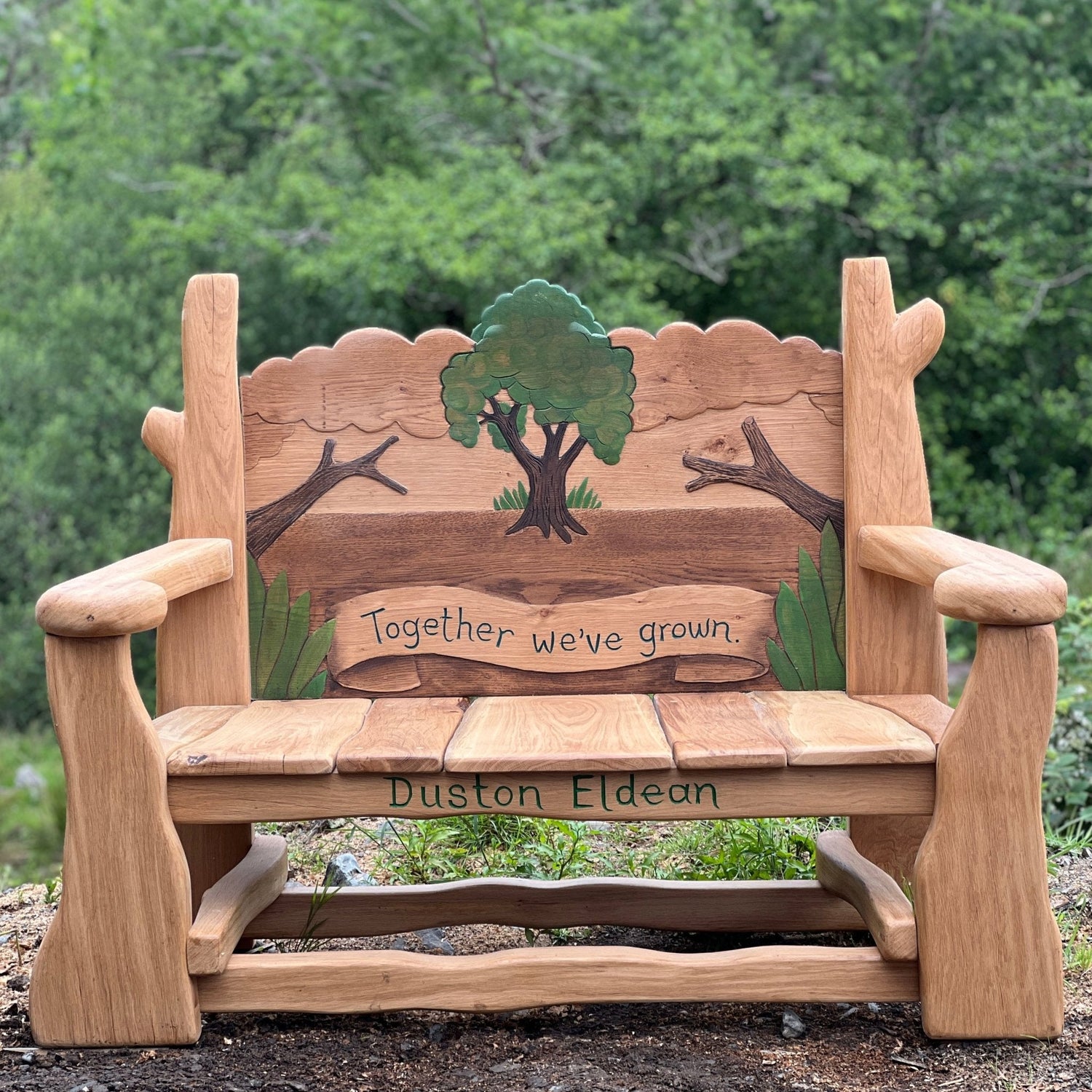
Sometimes a single phrase carries a whole community. When Duston Eldean school commissioned a bench, they brought us three words — "Together we've grown" — and we built the whole design around them: a hand-carved central tree (the school), its branches (the children), its roots (everything that came before). Some phrases earn their permanence, and that's one of them.

When the Words Are for a Child
There is no harder inscription to write, and we never rush it. We'll move at whatever pace feels right and keep working until the words feel true.
For Billy — a little boy whose mum first described him as "a little superhero" — the words chose themselves. His motto had been "I am brave, I am strong, and I can do scary things," so we carved it into the backrest beneath the title BILLY THE BRAVE, with sunflowers, lightning bolts and comic-book POW! and WHAM!, so his school could keep hearing his motto after he was gone.
And when St Helens Cemetery asked us to make a bench for the Babies and Infants section, we carved a line many bereaved families already know in their hearts: "We will look for you in rainbows," arching over a woodland scene, with the words Forever Loved on the front panel. It says what a rainbow says, in the moment you need it said.

Sometimes a Symbol Says It
Words aren't the only way a bench speaks. A carved motif can hold as much meaning as a sentence — and often the two work together. Sue's elephants, George's rugby rose, the skylarks we carved for Randwick Primary all do this.
That Skylark bench remembers Isabel and Brian Stanley, who gave so much to the school. Below their dedication we carved two words that said everything else that needed saying: Fly high. The birds rise through open sky across the backrest, and the whole bench feels like it's reaching upward. If the person you're remembering is bound up with an animal, a place, a badge or a hobby, that imagery is often the truest starting point of all.

How We Actually Put the Words On
One thing worth knowing about our benches: we carve the lettering directly into the solid oak, rather than bolting on a metal plaque. It's slower, but it means the words are part of the bench itself — they weather with it, they can't work loose, and they can be stained or painted to stand out. Here's what's worth thinking about either way.
Length. The more words you carve, the smaller each one has to be, and the harder it is to read from a seated position. As a rough guide, a comfortable, clear inscription sits around 80–120 characters including spaces. Longer is possible — Fred's two inscriptions are proof — but it's worth being deliberate about it.
Style. Simple, traditional lettering reads well outdoors and ages gracefully. Fancier scripts look lovely up close but get harder to read at a distance and at smaller sizes. If you're unsure, plainer is rarely wrong.
Proofing. This one matters more than any other. Read your wording out loud. Then read it backwards, word by word. Then have someone else check it. A carved mistake is painful to live with — so we always confirm the exact wording with you, in writing, before a chisel touches the wood.
Real Inscriptions From Benches We've Made
If it helps to see the range, here are real inscriptions that ended up carved into benches in our workshop — from the plainest to the most personal:
A whole community in three words:
Together we've grown
A line the person lived by:
Imagine all the people, living life in peace
Written by a husband, for his wife:
Sunshine Sue, you will remain in our hearts forever, and we know your spirit dances with the stars
For a much-loved teacher and friend:
In memory of our dear friends Isabel and Brian Stanley, who gave so much to the Randwick Primary School community — Fly high
A child's own motto:
I am brave, I am strong, and I can do scary things
Gentle, for the smallest losses:
We will look for you in rainbows · Forever Loved
Simple and traditional:
In Loving Memory of George Frederick Bailey, 1961–2018
There's no right answer. There's only what feels true.
Take Your Time — and Let Us Help
If you're not sure yet, wait. There's no urgency. Some people know their words immediately; others need months before they come. Both are completely fine.
When you're ready, have a look through our memorial bench collection — every bench in it was made for a real person, so you'll find no shortage of ideas. We make each one to order from solid Welsh oak, and the wording is something we work out with you: you bring us the name, the story and the things that mattered, and we'll help shape it, sketch the design, and confirm every word before anything is carved. If you have a particular vision — a size, a setting, a motif — get in touch and we'll start the conversation. We're here, and we'll take as much care with your bench as we have with every one before it.