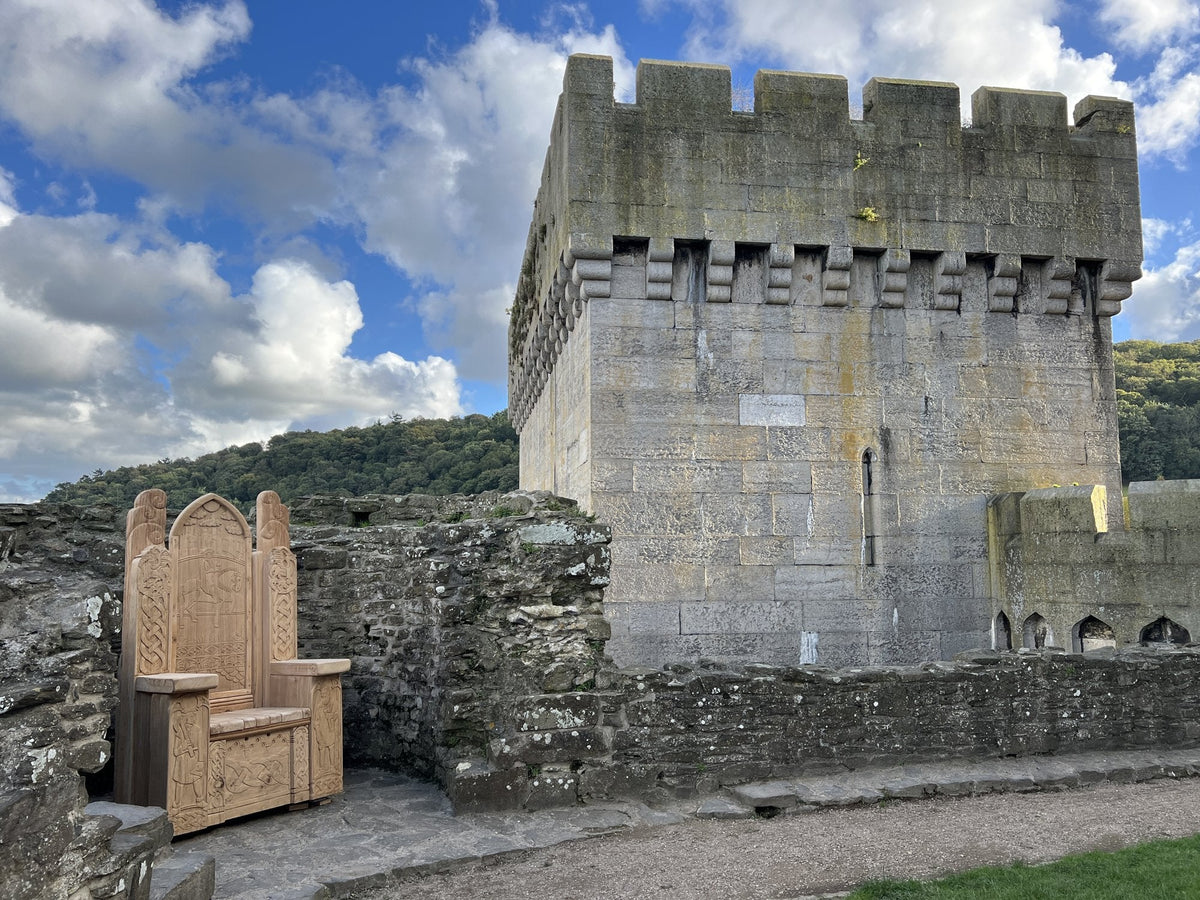
In the spring of 2024, Cadw asked us to make a chair for the walls of Conwy Castle.
That is not a sentence we get to write very often. Conwy is one of the great medieval fortresses of Europe — a UNESCO World Heritage Site, eight towers, walls that still ring the whole town — and the brief was simple in the way that only very hard briefs are: make something that feels as though it belongs there. Not a piece of furniture placed in a castle, but a piece of the castle.
This is what we made, and how.
The brief
Cadw's visitor services team wanted a large sculptural seat for the battlements — somewhere for visitors to sit, for children to climb into and become someone from another century, and for photographs to be taken against the towers and the estuary. It needed to live outside, permanently, in North Wales weather. It needed to be heavy enough not to move and robust enough to be sat in by thousands of people a year. And it needed to carry the castle's own history rather than a generic idea of “medieval”.
We had made something on this scale before — the four storytelling chairs and a circular bench we carved for Meirion's Trail, the permanent storytelling walk through Harlech, a few miles down the coast — and that was the reference point: solid oak, hand-carved throughout, left to weather naturally to the silver-grey of the stone.

Getting the story right
Our first drawing told the story of Owain Glyndŵr — a victorious prince returning to the castle. Cadw's team came back with a note that made the piece far better: it wasn't Glyndŵr who took Conwy, they said. It was two of his supporters, and they didn't take it by force at all.
On Good Friday 1401, with Glyndŵr's rebellion under way, the brothers Gwilym and Rhys ap Tudur waited until the castle's garrison had gone to church in the town. A man went to the gate dressed as a carpenter, saying he'd come to finish some work. The guards let him in. Behind him came forty men, and by the time the garrison came back from their prayers, Conwy Castle belonged to the Welsh.
Could the chair tell that story instead?
It could. Suzanne redrew it that week, and the carpenters became the heart of the piece.
What's carved where

The backrest is a pointed arch, carved in relief with a rider on horseback approaching the castle. Above him, the skyline of Conwy's towers; above that, a sky of scrolling clouds. Below the rider, three bands of medieval ornament — leaves, roundels, scalloped edging — of the kind you'd find on a carved bench-end in a Welsh church.
The uprights either side of the backrest carry a Welsh dragon each, curling down into a run of Celtic knotwork that goes all the way to the arms.

The arm panels are the two carpenters — or rather, the two soldiers pretending to be carpenters. One with an axe over the shoulder and a saw in hand, the other with a mallet, a chisel and a bearded face that gives nothing away. The photograph above shows them on the workshop bench mid-way through: one finished, the other still drawn in pencil on the oak with the first cuts made and the chisel resting in the work. That's the whole process in one picture — a drawing, then weeks of removing everything that isn't the picture.
The seat rail below is knotwork again, with a row of small carved arches along the top edge that echo the castle's own arrow slits.
All of the carving is Dan's — our lead carver — working from Suzanne's drawings, in solid Welsh oak.
Built to stay outside

A chair for a castle wall has to be built differently from a chair for a house. This one is solid oak throughout, thick in section, with hand-built joinery designed to take weather and weight for decades. It is heavy enough that it doesn't need fixing down.
It went to Conwy unvarnished, by choice. Fresh oak is golden; left outside it silvers over a couple of seasons until it sits alongside the limestone as if it had always been there. We watched exactly that happen to the Pen y Graig throne at the top of Harlech, and Cadw wanted the same.

The throne was finished in August 2024, delivered to the castle in September, and sits now in a turret on the walls with Telford's suspension bridge on one side and the estuary on the other. Sit in it and turn round and this is your view.
If you look after a castle, a park, a trail or a public space
This is the kind of work we'd like to do more of. Large carved seating and sculpture for heritage sites, country parks, woodland trails, schools and town centres — pieces that tell the story of the place they're in and are built to last a lifetime outdoors.
We've done it for Cadw at Conwy, for Meirion's Trail in Harlech, and for dozens of schools across the UK. The process is the same every time: you tell us about the place and its stories, we come back with a drawing, and we go from there. Most pieces take six to twelve weeks from an agreed design, and we deliver and install anywhere in the UK.
Get in touch with a place and a story.